Titanic — Final Model Duel






Overview
Module 41 project (Profissão Cientista de Dados). A solution to Kaggle's Titanic: Machine Learning from Disaster competition, built as an engineering project: tested Python package, leak-free pipelines, reproducible experiments and a Docker environment.
| Final model | CV accuracy (5×3) | Kaggle score |
|---|---|---|
| Hard voting (LogReg + SVM + Random Forest + XGBoost) | 0.8503 | 0.77751 |
Highlights
- Leak-free group survival feature: a scikit-learn transformer using leave-one-out, recomputed inside each fold. On its own, it took logistic regression from 0.8294 to 0.8440
- Rigorous validation:
RepeatedStratifiedKFold(5×3), paired fold-by-fold comparison and separate seeds for search and evaluation - Decision criteria set before seeing results: class balancing and the woman-child-group rule were tested and discarded based on evidence
- End-to-end reproducible: locked dependencies, fixed seeds and Docker — the container reproduces local metrics to the 4th decimal place
- Code quality: 65 tests, ruff, pre-commit and Conventional Commits
Project Structure
titanic-duelo-final/
├── data/                  # raw, processed and submissions
├── models/                # trained .joblib models
├── notebooks/
│   ├── 01_eda.ipynb                                   # exploratory analysis
│   └── MOD41_EXERCICIO_DUELOFINAL_Renan_Toyoyama.ipynb  # delivery notebook
├── reports/               # results of each experiment + figures
├── src/titanic/           # features, transformers, models, evaluate,
│                          # tuning, ensemble, predict...
├── tests/                 # 65 tests (pytest)
├── Dockerfile / Makefile
├── pyproject.toml
└── requirements.lock
The core rule of the project: every statistic learned from the data lives inside the pipeline. Row-wise features (Title, FamilySize, Deck) are computed upfront; imputation, scaling and group survival are fitted within each fold.
Tech Stack
| Technology | Role |
|---|---|
| Python 3.11 | Main language |
| pandas | Data manipulation and feature engineering |
| scikit-learn | Pipelines, custom transformers, CV, tuning and ensembles |
| XGBoost | Gradient boosting model |
| imbalanced-learn | Class balancing experiment (SMOTE) |
| Matplotlib / Seaborn | Visualizations |
| pytest / ruff / pre-commit | Testing and code quality |
| Docker / Make / Kaggle CLI | Reproducible execution, data download and submission |
Methodology
- Decision-driven EDA: sex and class dominate; the title summarizes sex, age and status; ticket groups tend to survive or die together; a missing cabin is itself information.
- Features:
Title,FamilySize/FamilyBand,Deck/HasCabin,TicketGroupSize,FarePerPerson,Ageimputed by title median andgroup_survival(leave-one-out). - Preprocessing:
ColumnTransformerwith imputation,log1pon fare,StandardScaler(only for linear models/SVM) and one-hot encoding. - Validation:
RepeatedStratifiedKFold5×3 — a single 5-fold split varied by 0.7 p.p. - Class balancing: none ×
class_weight× SMOTE. No balancing won in 3 of 4 models. - Tuning:
GridSearchCV(LogReg, SVM) andRandomizedSearchCV(RF, XGBoost), re-evaluated with a different seed — revealing 0.77 p.p. of optimism in XGBoost. - Ensembles: out-of-fold error correlation showed two families (linear and tree-based); hard voting won.
Results
Project evolution
| Stage | Model | CV accuracy | Kaggle |
|---|---|---|---|
| Reference | "Only women survive" | — | ~0.766 |
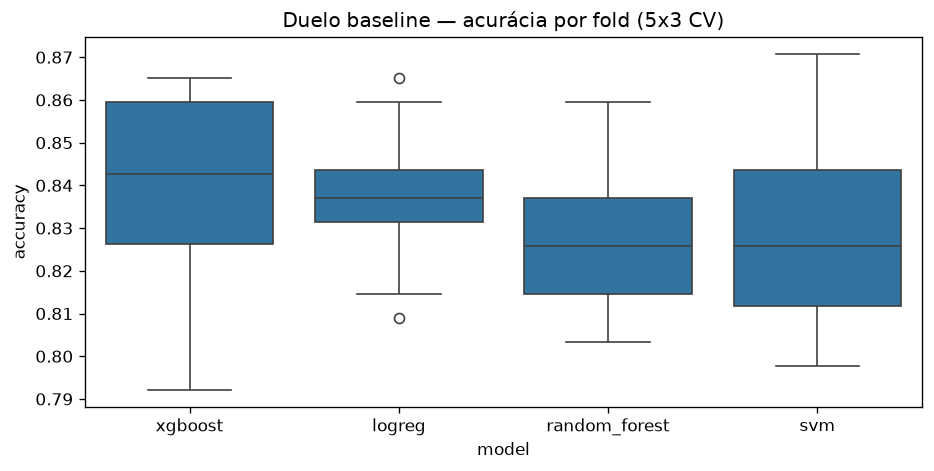
| Baseline | Logistic regression, default parameters | 0.8373 | — |
| Tuning | Tuned Random Forest | 0.8485 | 0.77751 |
| Ensemble | Hard voting | 0.8503 | 0.77751 |
Final duel
| Model | Accuracy | Std. dev. | ROC AUC | Win rate vs RF |
|---|---|---|---|---|
| Hard voting | 0.8503 | 0.0156 | — | 67% |
| Tuned Random Forest | 0.8485 | 0.0183 | 0.8894 | — |
| Stacking | 0.8444 | 0.0188 | 0.8930 | 33% |
| Soft voting | 0.8440 | 0.0167 | 0.8940 | 33% |
Experiments that didn't work
| Experiment | Result | Why |
|---|---|---|
SMOTE and class_weight |
Lower accuracy in 3 of 4 models | They shift the threshold toward the minority class; with a 62/38 split this causes more errors than hits |
| Stacking and soft voting | Best AUC, worst accuracy | Averaging probabilities pulls values toward the middle and borderline passengers flip sides |
| Woman-child-group rule | 7–33% win rate | Redundant: group_survival + Title + Sex already captured the pattern |
Lessons learned
- Every statistic learned from the data goes inside the pipeline.
- A difference in the mean is not a real difference: XGBoost "led" the baseline while winning only 40% of folds.
- The best score of a search is optimistic; re-evaluating with another seed measures that bias.
- The best model depends on the metric: the AUC champion was last in accuracy.
- CV is an estimate, not a promise: 0.85 in CV became 0.78 on Kaggle.
How to Run
Prerequisites
Kaggle token saved at ~/.kaggle/access_token and competition rules
accepted via Join Competition on the Titanic page.
Main targets: make baseline, make balance, make tune, make ensemble,
make wcg, make predict and make submit.
Note
The notebooks and documentation are written in Portuguese.